
Inositol and PCOS: evidence, forms and how to compare supplements
Understand the ingredient names, the format, and the questions worth asking before choosing a supplement.
One search for inositol can leave you with more tabs open than answers.
Myo-inositol. D-chiro-inositol. A 40:1 ratio. Capsules or powder. If you’re trying to understand where a supplement fits into life with PCOS, all those details can blur together.
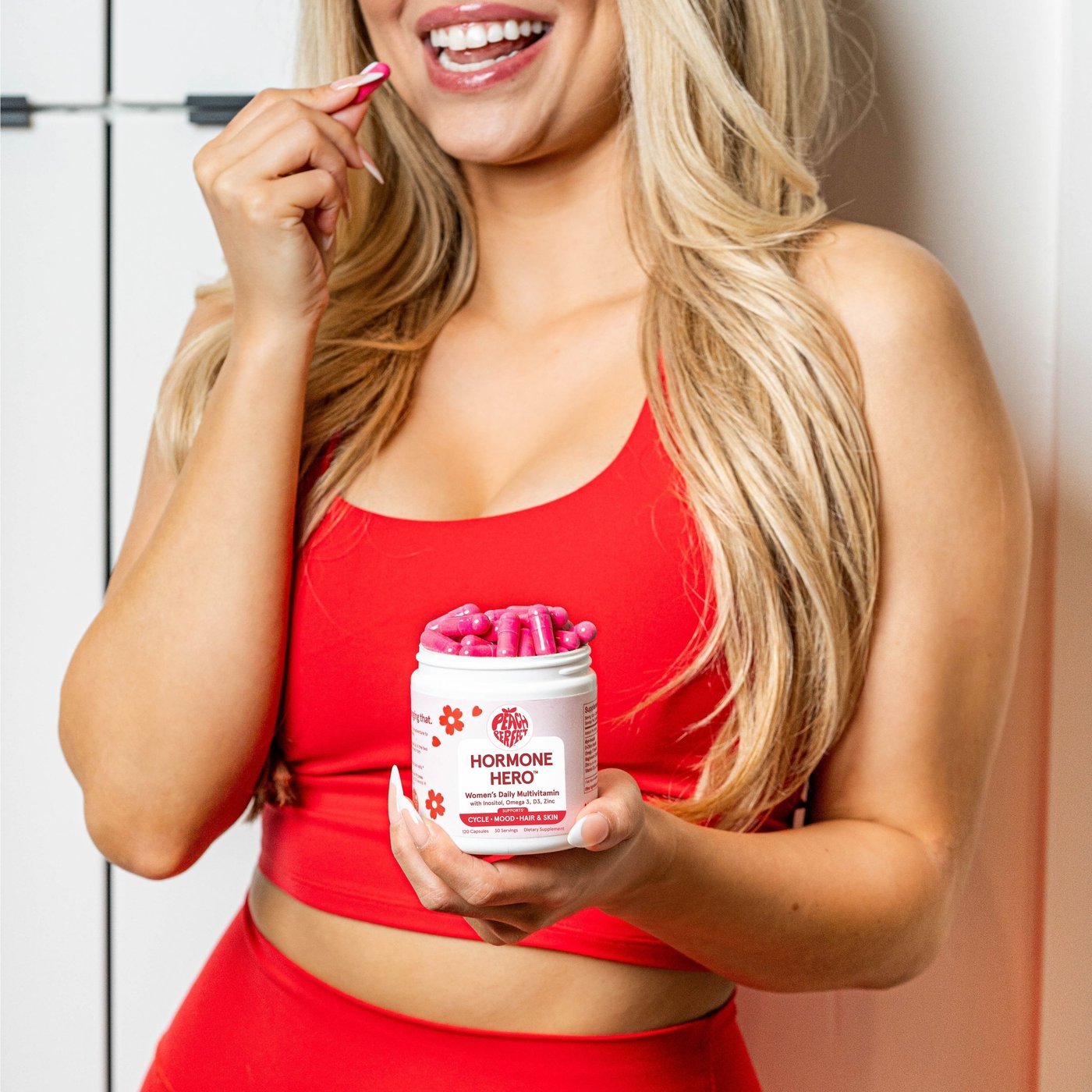
Let’s separate them. First, what the research can tell you. Then, a real look inside Hormone Hero capsules, so the numbers on the label start to make sense.
Your label-reading shortcut
How to choose an inositol supplement
Start with the forms and milligrams per serving, then compare the complete formula, a format you can use as directed, product-specific testing documentation and price per labeled serving. A familiar ratio or a bigger bottle cannot answer all of those questions.
Choosing for PCOS? Start with what the evidence says. The international guideline does not recommend a specific type, dose or combination of inositol. A clearer label helps you compare products; it does not establish which treatment is right for you.
| Your question | Where to look |
|---|---|
| Do they contain the same inositol? | Read the form names, then compare amounts per serving. |
| Both say 40:1. Are they equivalent? | See why the same ratio can mean different amounts. |
| Which fits my routine? | Compare capsules and powder, including serving directions and other ingredients. |
| What supports the quality claims? | Check which product, lot and tests the documentation covers. |
| Which is better value? | Compare price per labeled serving alongside the amounts of each form. |
What the evidence says, first
The 2023 international guideline, now using PMOS/PCOS terminology, allows consideration of inositol based on personal preferences while describing limited clinical benefits. It does not identify a recommended type, dose or combination because the evidence is insufficient.
For infertility, it treats inositol as experimental, with benefits and risks too uncertain to recommend it as fertility therapy. Tell your healthcare professional about supplements you take. See recommendations 4.7 and 5.8.
The rest of this guide helps you compare labels; it does not establish that a supplement treats your condition.
One word, several compounds
Inositol occurs in different forms called stereoisomers. Two names you may see on supplements are myo-inositol and D-chiro-inositol. PubChem’s myo-inositol record explains the terminology. Do not assume two products using the word inositol contain the same forms or amounts.
So the first label question is which form you are looking at. Look for myo-inositol or D-chiro-inositol (sometimes written DCI) in the ingredient line. If it simply says “inositol” and you are unsure which form is meant, ask the manufacturer. If both forms are listed, note each amount.
Where to lookThe Supplement Facts panel, in the ingredient name itself. The front of the pack may say “inositol” alone or show a ratio without naming the forms.
Amounts, not just names
Supplement Facts panels give amounts per serving, and a serving is whatever the label says it is: two capsules, four capsules, one scoop. Read the serving size first, then the milligrams of each form, then the servings per container. Two products can list the same milligrams per serving and differ by a factor of two in what you take per day, depending on the directions.
Watch for proprietary blends. If the inositols sit inside a blend with a single total weight, the panel is not telling you how much of each form you get. Treat that as a missing answer rather than a neutral one.
Ratio versus amount
Some inositol products display a ratio such as 40:1. It describes the proportion of myo-inositol to D-chiro-inositol in the formula. It does not describe quantity.
Here is the arithmetic. A serving with 2,000 mg of myo-inositol and 50 mg of D-chiro-inositol is 40:1. So is a serving with 4,000 mg and 100 mg, and so is one with 400 mg and 10 mg. The ratio is identical; the amount differs tenfold. If a label gives a ratio, look for the absolute milligrams of each form on the panel, and compare those.
Bars show myo-inositol amounts on the same scale: 400, 2,000 and 4,000 mg. Both ingredient amounts are listed. Every example has a 40:1 ratio.
A word of caution about ratios in general. The guideline’s position is that no specific type, dose or combination of inositol can currently be recommended for PCOS.1 A ratio on a label is a description of a formula, not a finding about what works. Treat it as information for comparison, nothing more.
Inside Hormone Hero capsules
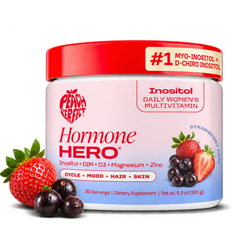
Serving size: 4 capsules
Servings per container: 30
| Ingredient | Amount |
|---|---|
| Myo-inositol | 2,000 mg |
| D-chiro inositol | 50 mg |
| Omega 3 powder | 300 mg |
| Magnesium glycinate | 200 mg |
| Zinc (as zinc citrate) | 10 mg |
| Vitamin D3 (as cholecalciferol) | 25 mcg (1,000 IU) |
Other ingredients: Gelatin (capsule).

Read these amounts as one four-capsule serving. The two inositol lines make the ratio easy to see: 2,000 ÷ 50 = 40. And 120 capsules divided by four per serving gives 30 servings. This is the capsule formula; powder formats have their own labels.
The rest of the ingredient list
An inositol supplement may also contain vitamins, minerals or other dietary ingredients. Check each added ingredient and its amount rather than judging the formula by the length of its ingredient list. An ingredient study does not automatically establish how a finished combination performs. A claim about a complete formula needs evidence that actually evaluates that formula. Compare the complete formulas as well as the inositol amounts.
Where to lookStart with Supplement Facts for dietary ingredients and their amounts. Then read “Other ingredients” for items such as capsule materials, flavors and sweeteners. These are separate parts of the label. FDA explains the distinction.
Capsules or powder
Inositol supplements are available as capsules and powders. Products in those formats are not necessarily equivalent.
Capsules deliver a fixed amount per capsule, so a serving is a count: two, three, four. Check the number of capsules in a labeled serving and follow that product’s directions. The capsule count on the bottle is not automatically its serving count.
For a powder, check the amount per labeled serving, the measuring instructions and the complete ingredient list. Some powders are flavored; others are not. Do not assume that a scoop contains more inositol than a capsule serving.
Format alone does not establish equivalence. Consider the complete formula, directions and your preferences together.
Capsules and powder, question by question
Use this side-by-side checklist when you’re deciding which format fits your routine.
| Label question | Capsules | Powder |
|---|---|---|
| Which forms are named? | Myo-inositol, D-chiro-inositol or both, in the ingredient line | Look for the named forms in Supplement Facts, then compare with any front-label ratio |
| How much of each per serving? | Fixed per capsule; the serving is a stated count of capsules | Per scoop; check the scoop size in grams and whether it is level |
| Ratio or amount? | Ratio may be on the front; milligrams of each form on the panel | The same check; compare the stated amounts rather than assuming powder contains more |
| What else is in it? | Added nutrients with amounts; capsule shell and fillers under “Other ingredients” | Added nutrients with amounts; flavors, sweeteners and anti-caking agents |
| How many servings in the container? | Capsule count divided by capsules per serving | The stated servings, or net weight divided by scoop size |
| Is there documentation for this product? | Ask what product- or lot-specific documentation is available | Ask which exact powder product and lot the documentation covers |
| What does a serving cost? | Price divided by servings, compared at equal milligrams of each form | The same arithmetic |
Documentation and price per serving
FDA does not approve dietary supplements before they are marketed. Product-specific documentation is a separate question from approval.3 The practical response is to ask for product-specific documentation: a certificate of analysis for the product or its lot, or a listing in a named third-party testing program. Read what the documentation actually covers: product, lot, date, tests and results. A report about one test does not establish every quality or suitability claim.
Then do the arithmetic. Divide the price by the labeled servings per container, and compare at equal milligrams of each inositol form. A bottle of 120 capsules at four per serving is 30 servings, not 120.
NoteCompare the current price against 30 labeled servings for Hormone Hero capsules, rather than the bottle’s 120-capsule count.
Questions
Is myo-inositol the same as D-chiro-inositol?
No. They are different forms of the same family of compounds, studied and labeled separately. A label should name which it contains and how much of each.
Does a 40:1 label mean a product is better?
It means the formula has forty parts myo-inositol to one part D-chiro-inositol. It says nothing about the amount per serving, and the 2023 guideline does not recommend any specific type, dose or combination.1
Can inositol treat PCOS or help me conceive?
This article does not give medical advice. The 2023 international guideline describes inositol’s clinical benefits as limited and calls it experimental for infertility, with benefits and risks too uncertain to recommend it as a fertility therapy. Decisions about managing PCOS belong with you and your clinician.
Capsules or powder: which should I choose?
Compare the complete formula, labeled amounts, directions and price per serving. Choose a format you can use as directed; neither format automatically contains more inositol.
What side effects have been reported with myo-inositol?
In a 2024 systematic review of women with PCOS, myo-inositol likely caused fewer gastrointestinal adverse events than metformin; reported events were typically mild and self-limited.4 That comparison is not a complete list of possible side effects or a prediction of any one person’s response. The review described the overall PCOS evidence as limited and inconclusive. If you take medicine or manage a health condition, discuss the exact supplement with a qualified healthcare professional.
Sources
- Teede HJ, Tay CT, Laven J, et al. International Evidence-based Guideline for the assessment and management of polyendocrine metabolic ovarian syndrome 2023. Monash University, terminology-updated edition linked June 2026. Section 4.7 (Inositol) and section 5.8 (Inositol, infertility). Accessed October 27, 2026. Monash guideline, terminology updated in 2026
- NIH PubChem. Myo-inositol compound record. Chemical naming reference; not evidence of clinical benefit.
- US Food and Drug Administration. Questions and answers on dietary supplements; Supplement Facts and proprietary blends. Label-reading and regulatory context.
- Fitz V, Graca S, Pateguana M, et al. Inositol for Polycystic Ovary Syndrome: A Systematic Review and Meta-analysis to Inform the 2023 Update of the International Evidence-based PCOS Guidelines. The Journal of Clinical Endocrinology & Metabolism. 2024;109(6):1630–1655. doi:10.1210/clinem/dgad762. Read the systematic review.
The guideline discusses inositol as an ingredient. It does not evaluate our finished formula.