


What happens when you stop taking creatine?
A change in your supplement routine is not a verdict on your progress. Here’s what the research can—and cannot—tell you.

Your muscle stores change gradually
When supplementation stops, elevated muscle creatine stores can move back toward their earlier level over several weeks. Research observations are not a personal countdown: they do not tell you exactly when your weight, appearance or performance will change.
Three questions often get bundled together: what happens to muscle creatine, what happens on the scale, and what happens in the gym. Keeping them separate makes the answer more useful. Stopping a supplement and stopping resistance training are also different changes.
What “back to baseline” meant in research
In a 1996 study involving 31 men, researchers investigated muscle creatine under different supplementation schedules. In the condition without continued maintenance, total muscle creatine declined gradually and was no different from the presupplementation value 30 days after cessation.
That is a measurement in a particular research protocol. It does not mean everyone returns to baseline on day 30, that a scale change follows the same schedule, or that all training progress disappears. The male study population also limits how confidently that timeline can be applied to women.
A 1999 study reported elevated muscle creatine measures two weeks after supplementation and a return to basal levels at four weeks. It did not find improved maximal intermittent cycling performance despite the increase in muscle stores. That is a useful reminder that a laboratory measure and a performance outcome need not move together.
A scale change is not a muscle-loss test
The NIH ODS overview notes that creatine supplementation can increase weight through water retention. That makes it especially important not to read a scale change as a direct measurement of muscle tissue or fat. The overview does not give an exact amount of weight that every person will lose after stopping.
If you track your weight, compare measurements under similar conditions and look at a pattern rather than a single reading. Record other changes, too: your exercise schedule, usual meals, travel or illness. This is a way to organize observations, not a method for diagnosing the cause of weight changes.
Photos, how clothing fits, and day-to-day scale readings cannot isolate muscle creatine stores. They also cannot tell you whether an unexplained symptom is harmless. Seek medical advice for concerning or persistent changes rather than attributing everything to your supplement routine.
Put training performance in context
It would be misleading to promise that stopping creatine cannot affect anyone’s performance. It would also be misleading to predict a strength drop in a particular week for every reader. The studies above do not provide that kind of individual forecast.
If you keep a training log, continue recording the same kinds of observations: the exercise, load, repetitions and how the session felt. Note whether the program itself changed. A harder exercise selection, a lighter week, a different rest interval or a missed session complicates any comparison.
For example, comparing a set of squats one week with a different exercise the next is not a clean test of stopping creatine. Even a well-kept personal log cannot prove cause and effect, but it can make a conversation with a qualified coach or clinician more specific.
You do not have to turn a pause into a complicated protocol
A pause may be about budget, preference, travel or advice from a healthcare professional. Those reasons deserve different follow-up questions. This article does not prescribe tapering, a washout schedule or a new loading phase. If you decide to restart, follow the directions for your current product rather than treating a previous routine as automatically appropriate.
Your body also produces creatine, and some comes from food; stopping a supplement does not mean all creatine disappears from your body. That basic distinction does not establish how you personally will respond.
If you are stopping because of a suspected reaction, the FDA’s supplement guidance advises stopping use and seeking medical advice. Keep the product name and label available for that conversation. Do not restart solely to test whether the symptom returns.
Keep a simple record of what changed
A short note can be more useful than a strict countdown. Record the product and format, when you stopped, why you stopped, and any other changes to your training or routine. If you have a specific concern, write it as a question—for example, “Is this symptom something that needs evaluation?”
For a scheduling question rather than a stopping question, our creatine timing guide compares before-and-after-workout research. For product directions, see how to read your creatine label. Neither guide replaces individualized medical advice.
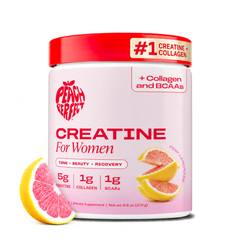
Peach Perfect sells creatine products. You do not need a sales pitch to understand a break from supplementation: the aim here is to separate what was measured in research from what remains uncertain for you.
A few more good questions
How long does it take creatine stores to return to baseline?
The studies summarized here observed a return toward baseline over several weeks, including measurements around four weeks. Those are study-specific observations, not an exact deadline for every individual.
Will I lose a certain number of pounds?
There is no reliable universal number in the sources discussed here. A change in scale weight is not a direct measure of muscle tissue, fat or muscle creatine.
Does stopping creatine mean I lose all my progress?
The studies discussed here do not establish that conclusion. Muscle creatine stores and training adaptations are different things, and an individual performance change cannot be predicted from a fixed countdown.
Should I restart if I notice an unwanted change?
Do not restart solely as a test of an unexplained symptom. Seek appropriate medical advice, especially if you stopped because of a suspected reaction.
Sources
- Hultman et al., 1996 muscle creatine study — Decline in muscle creatine after cessation under a specific protocol.
- McKenna et al., 1999 muscle creatine and exercise study — Distinguishes muscle stores from measured exercise performance.
- NIH ODS: exercise and athletic performance — Body production, food sources and water-related weight context.
- FDA 101: dietary supplements — Response to a suspected adverse reaction.