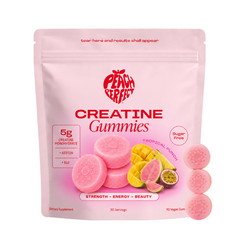


Serving directions belong to the exact product label—not a one-size-fits-all prescription.
The quick answer
If you have searched “creatine dosage for women,” you have probably seen a few different numbers—and a lot of confident advice. The research does not establish one personalized dose for every woman. The National Institutes of Health Office of Dietary Supplements (NIH ODS) describes common adult research protocols that are the same regardless of sex or body size. Those study protocols are useful context, not a prescription for you or directions for a specific product.
For creatine monohydrate, NIH ODS lists a common adult study protocol of 20 grams per day in divided portions for 5–7 days, followed by 3–5 grams per day. It also describes a non-loading protocol of about 3–6 grams per day for 3–4 weeks. A 2026 systematic review focused on females found varied protocols and concluded that certainty remains low or very low for important outcomes—so it does not support a universal recommendation.
If you are deciding whether to take creatine, start with your own health context and the exact supplement label. A clinician or registered dietitian can help you interpret that information for you.
What adult studies use—and what those numbers mean
Creatine studies do not all use the same schedule. NIH ODS summarizes two common approaches for adults:
| Protocol described in the research | What it looks like | How to read it |
|---|---|---|
| Loading, then maintenance | 20 g/day, divided into four 5 g portions, for 5–7 days; then 3–5 g/day | A common adult research protocol—not a requirement and not individualized advice. |
| No loading phase | About 3–6 g/day for 3–4 weeks | Another protocol reported in adult studies; the slower schedule is not a recommendation for any particular person. |
These amounts refer to creatine itself in a study protocol. A scoop’s volume is not a reliable way to infer grams, and products can have different serving sizes and ingredient amounts. Read the exact product label rather than borrowing a number from a different format.
What research in women shows
A September 2026 systematic review and meta-analysis included 34 studies and 692 female or female-eligible participants; 21 studies contributed to its main quantitative analysis. The authors found possible small average effects for selected exercise-performance and body-composition outcomes, but substantial differences across studies and low or very-low certainty limited firm conclusions. The review says the available evidence does not warrant a universal recommendation.
That matters for a dosage question: the adult protocols reported by NIH ODS explain what researchers have commonly studied, but they do not prove that every woman needs the same amount or schedule. Research outcomes can also depend on the population, the form studied, training context, duration and measured result. A study amount should not be mistaken for a personal target.
Creatine monohydrate is the most widely studied form in the NIH ODS fact sheet. A dosing study does not, by itself, answer separate questions about cognition, bone health or a medical condition; those claims need evidence specific to the outcome and population.
Do you need a loading phase?
Loading is one research approach, not the only one. NIH ODS also describes studies using a daily amount without a loading phase over several weeks. Which option is appropriate for an individual depends on more than a blog article; the sources here do not establish a personal plan or say that a loading phase is necessary for every woman.
If a label gives directions, those directions apply to that specific product. Do not translate an adult research protocol into instructions for a different supplement format, and do not take more than the label directs without advice from a qualified health professional.
How to read a creatine serving
Before comparing numbers, check three things on the exact label:
- Ingredient: Is the amount stated for creatine monohydrate itself, or for a blend of multiple ingredients?
- Amount per serving: How many grams are listed, and how many scoops, capsules or pieces make up that labeled serving?
- Directions and cautions: Follow the package directions and note any warnings relevant to your health or medications.
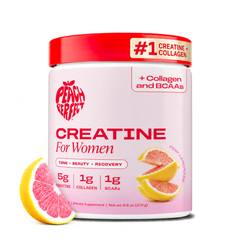
Serving formats are not interchangeable. A product’s serving count, gram amount and directions must come from that product’s current approved label. This guide does not supply a brand-specific dose.
For the broader routine question, see our guide to building a creatine routine. That article is also general information, not a substitute for individualized advice.
Questions people ask
Is there a different creatine dose just because I’m a woman?
NIH ODS describes a common adult protocol regardless of sex or body size, but that does not establish an individualized dose. The female-specific evidence remains varied, and the 2026 review does not support a universal recommendation.
Is 3–5 grams a recommendation for me?
No. NIH ODS reports 3–5 g/day as a maintenance amount in one common adult research protocol. It is not a personalized recommendation for every reader or a direction for every product.
Do I have to load?
Not according to the fact sheet’s summary of research: it describes both loading and non-loading protocols. This article cannot determine which, if either, is appropriate for you.
Can I use the scoop that came with another product?
Do not assume it measures the same amount. Use the serving information and measuring directions for the exact product you are considering.
Sources
- NIH Office of Dietary Supplements, Dietary Supplements for Exercise and Athletic Performance: Health Professional Fact Sheet. See the creatine efficacy, safety and implications-for-use sections for adult study protocols and evidence scope.
- Lin, Zhu and Hong, Effects of creatine supplementation on exercise performance, physiological outcomes, and body composition in females engaged in exercise or training: a systematic review and multilevel meta-analysis. Frontiers in Nutrition, September 4, 2026. The authors report substantial heterogeneity and low or very-low certainty for key estimates.
This informational article is written by Peach Perfect. It is not medical advice, does not recommend a dose or product, and has not been independently medically reviewed. For advice that accounts for your health, medications and circumstances, speak with a qualified health professional.