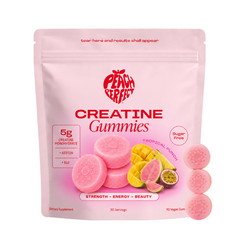

Does creatine expire? Start with your label.
That tub at the back of the cupboard deserves a closer look—not a guess based on how well it mixes.

The date belongs to the product
Use the date and storage instructions for your exact product. There is no single shelf life that this article can assign to every creatine powder, flavored blend or other format. An ingredient’s stability in a laboratory does not establish the shelf life of your opened container.
Start with the package you actually have. Check the date wording, the lot or batch code, the storage instructions and whether the seal or container has been damaged. If a date is unclear or has passed, ask the manufacturer about that product and lot rather than using a general internet timeline to extend it.
An expiry date and a batch code do different jobs
A batch code helps the manufacturer identify a production batch. It is not necessarily a date you can decode yourself. A manufacturing date tells you when something was made; it is not automatically a use-by date. Read the words beside the numbers before deciding what they mean.
The FDA’s dietary supplement labeling guide explains that expiration dating is not required on dietary supplement labels, but a firm may include it when valid data support the statement. A missing date is therefore not, by itself, a promise of indefinite shelf life—or proof that the product is spoiled.
If the printing is rubbed away or the format is ambiguous, photograph the container and send the brand the lot code. Ask it to identify the date and explain the applicable storage guidance. Keep the original package while the question is being resolved.
Dry powder and a mixed drink are different situations
A 2003 laboratory study examined solutions prepared from effervescent powders containing di-creatine citrate, stored at room temperature or refrigerated over 45 days. Researchers measured creatine concentration and examined crystal formation.
That is a very different setup from a sealed tub of dry powder or a drink prepared for immediate use. Its results cannot set a universal “safe for this many hours” rule for every beverage, and they do not prove that dry creatine becomes ineffective the moment it touches water.
If you plan to mix a product in advance, follow the preparation and storage instructions for both the supplement and the beverage. Milk, juice and a multi-ingredient shake are not interchangeable with the study’s solution. Ask the manufacturer if its instructions do not cover your intended preparation.
Clumps and mixing are observations, not potency tests
A change in appearance, texture or smell is worth checking, particularly if it is unexpected for that exact product. But a photograph of clumps cannot measure how much creatine remains. Nor can a home mixing test establish purity, contamination or a percentage of potency.
The laboratory study above used analytical equipment to measure concentration. A spoon, a glass of warm water and a stopwatch are not substitutes for that analysis. Avoid advice that promises you can prove a product is fresh simply by watching how quickly it dissolves.
Do not taste a questionable product as a test. If you see suspected contamination, damage or an unexpected change, set it aside and contact the manufacturer. A normal-looking powder is not a guarantee that storage conditions or product quality were acceptable.
Make your next storage check easy
Keep the product’s directions accessible and follow them for temperature, moisture, light and handling. Avoid transferring the contents into an unmarked decorative jar: keeping the original label, lot code and directions together makes future questions much easier to answer.
Make a short note of when you opened the container if that helps you remember its history. The note is useful context; it does not create a new expiry date. If the product spent time somewhere outside its labeled storage conditions, tell the manufacturer what happened rather than assuming the printed date still answers the question.
A helpful message might read: “I have [exact product and flavor], lot [code]. The package says [date wording]. I opened it on [date] and stored it [conditions]. Can you confirm the date and whether this situation is covered by your storage guidance?” This is a template for gathering facts, not a way to certify the product at home.
Better questions before your next purchase
Before buying a replacement, compare the amount you expect to use with the labeled servings per container. Check that the storage directions fit where you will keep it, and make sure you can identify the exact product and flavor if you need support later.
Our creatine quality guide separates identity, documentation and suitability. Our label-reading guide explains serving size and directions. Those are useful buying checks even when an expiry date is not your immediate concern.
Peach Perfect sells supplements. This guide does not assign a shelf life to a Peach Perfect product or extend any date printed on its packaging.
A few more good questions
Can I use creatine after its printed date?
This article cannot verify an expired product’s quality or suitability. Ask the manufacturer about the exact product, lot and storage history rather than extending the date based on a generic shelf-life claim.
Does clumping prove the creatine has degraded?
Clumping alone cannot quantify remaining creatine or establish product quality. Unexpected changes should be raised with the manufacturer; do not use taste or a home dissolve test as a substitute for assessment.
Does refrigeration guarantee a mixed drink stays usable?
No universal storage guarantee follows from the study discussed here. Follow the instructions for the supplement and all beverage ingredients; ask the manufacturer about advance preparation if needed.
Sources
- FDA dietary supplement labeling guide, question 14 — Voluntary expiration dates need supporting data.
- Ganguly et al., 2003 laboratory study — Distinguishes solution testing from dry finished-product shelf life and home mixing observations.