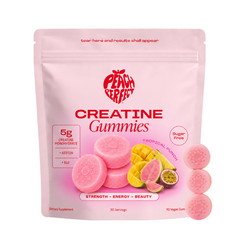

Best Creatine for Muscle Growth: What the Evidence Says
A clear, evidence-led guide to choosing creatine for training: what research in women says, how to read labels, and why no product can promise a set result.
If you are choosing creatine for muscle growth, start with two questions: what does research show when it is paired with resistance training, and what should the label tell you? The answer is more useful than a promise of a specific body change.

The short answer
Creatine monohydrate is the most studied form. When paired with resistance training, creatine may offer small average benefits for some outcomes, but the evidence in women is still low or very low in certainty and cannot predict one person’s result. A label, blend or price cannot promise muscle growth.
What the research says about creatine and muscle
Creatine supports the phosphocreatine system used to rapidly restore energy during short, intense efforts such as repeated hard sets. The NIH Office of Dietary Supplements describes its best-supported role in repeated high-intensity activity, including weight lifting. That makes it a training-support question, not a guarantee of muscle growth on its own.
A 2026 systematic review focused on women and exercise included 34 studies in its qualitative review; 21 studies contributed to its quantitative analysis. The authors found possible small effects in selected performance and body-composition measures, but rated certainty low or very low and noted that body-composition outcomes did not all move in a uniformly favorable direction. A pooled result cannot predict what one person will experience.
A separate 2023 meta-analysis looked specifically at direct, regional measures of muscle hypertrophy during resistance training. Across 10 studies and 44 outcomes, its pooled estimate was very small and the credible interval included no effect. The authors described small possible benefits in muscle-thickness measures. This is more careful—and more useful—than promising a percentage increase to everyone.
So, what is the best creatine to choose?
For most people comparing creatine products, creatine monohydrate is the most studied form. The NIH fact sheet notes that other forms have not been shown to be superior to monohydrate for raising muscle creatine, digestibility, stability or safety. A different name, a premium price or a more complicated blend does not by itself establish better muscle results.
Use the label as your checklist:
- Form: identify whether the product contains creatine monohydrate or another form.
- Amount: read the amount of creatine per labeled serving; do not confuse total blend weight with creatine amount.
- Directions: follow the exact product directions. A study protocol is not a personal prescription.
- Documentation: look for clear ingredient and quality information, and verify any testing claim with the company or its documentation.
- Value: compare cost per labeled serving only after checking that the serving amounts are comparable.
Our creatine quality guide explains how to evaluate product information. Our creatine forms guide compares forms without treating a marketing label as proof of superior results.
How to think about muscle, water and scale changes
Body weight, body fat, lean mass and muscle size are different measures. Some creatine studies report an early increase in body water or body weight; a scale cannot tell you whether a change is muscle tissue, water or something else. Nor does a short-term change establish a lasting change in muscle size.
When you read a claim or a before-and-after story, ask: what was measured, for how long, in whom, and against what comparison? Was a training program part of the study? Did it test creatine as an ingredient or the finished product being advertised? These questions help separate a plausible training aid from promises that outrun the evidence.
What matters alongside a supplement
Resistance training supplies the stimulus. A repeatable plan lets you see whether your strength, reps or training tolerance are changing over time. Record the exercise, load and repetitions in a way that works for you; the record can describe your progress, but it cannot isolate a supplement’s effect from every other change.
If you are considering creatine, start with the question you want answered—form, serving directions, product quality or price. Our creatine dosage guide and routine guide cover those topics without turning a research protocol into individualized advice.
Talk with a healthcare professional about whether a supplement is appropriate for you, particularly if you have a medical condition, take medication, or are pregnant or breastfeeding. The FDA also recommends discussing dietary supplements with a healthcare professional.
Questions people ask
Does creatine build muscle without resistance training?
This guide focuses on creatine used alongside exercise or training. It is not evidence that creatine replaces a training stimulus or guarantees muscle growth without one.
Will creatine make my muscles grow by a specific amount?
No single percentage can predict an individual result. Studies differ in participants, training, duration, product protocols and the way muscle or body composition is measured.
Is a more expensive creatine better for muscle growth?
Price alone does not show that a product is more effective. Compare the creatine form, amount per labeled serving, directions, documentation and cost per comparable serving.
Does a scale increase mean I gained muscle?
Not necessarily. Body weight can reflect water and other changes as well as tissue. The scale does not identify the cause.
Sources
- NIH Office of Dietary Supplements: Dietary Supplements for Exercise and Athletic Performance — creatine’s role in high-intensity activity, product forms and general protocols.
- Lin et al., Frontiers in Nutrition (2026), systematic review and multilevel meta-analysis — female-specific exercise and body-composition evidence, including certainty limits.
- Burke et al., Nutrients (2023), systematic review and meta-analysis — direct regional measures of muscle hypertrophy with creatine plus resistance training.
- FDA: Questions and Answers on Dietary Supplements — consumer guidance on discussing supplement use with a health professional.
Peach Perfect sells supplements. This article discusses published research and does not claim that research on an ingredient establishes the results of any finished product.